
Intelligent Support for Skilled Workers Using Extended Reality

Extended Reality (XR)—including Virtual Reality (VR), Augmented Reality (AR), and Mixed Reality (MR)—opens up immersive learning and working environments while also enabling intelligent, context-aware support.

To unlock this potential, we develop solutions for the efficient creation and deployment of mixed reality applications that intelligently assist people in education and training, manufacturing, as well as maintenance and repair.

Intelligent support means that our solutions can recognize situations and provide adaptive, context-specific guidance. Our technologies flexibly respond to the specific requirements of the task at hand, as well as to the associated data flows and data preparation processes.
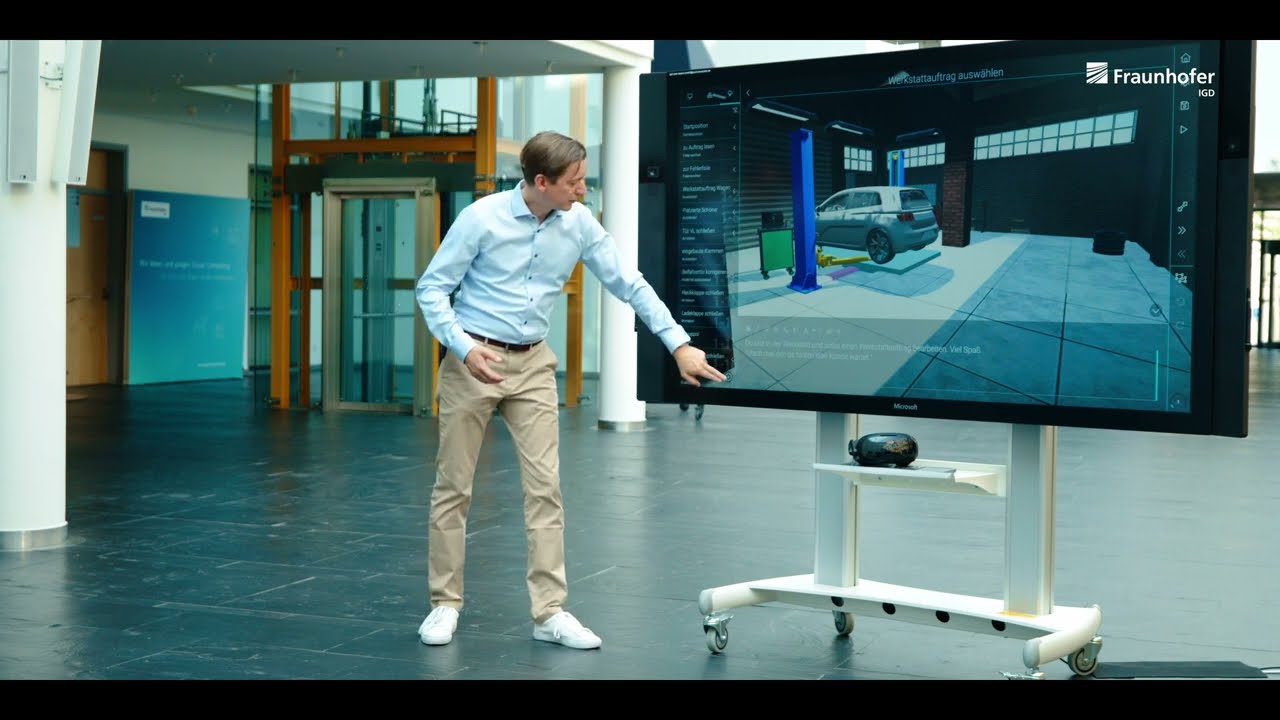
Training for the Future: Digitally Upskilling Professionals with Interactive VR Training

Privacy warning

With the click on the play button an external video from www.youtube.com is loaded and started. Your data is possible transferred and stored to third party. Do not start the video if you disagree. Find more about the youtube privacy statement under the following link: https://policies.google.com/privacy

How You Benefit from Our Solutions

Easy Creation and Integration

With our interactive authoring tools, trainers and instructors can create training scenarios themselves—without requiring specialized IT expertise. This makes the creation of immersive learning content cost-effective and significantly lowers barriers to adoption.

Thanks to efficient 3D data import from a wide range of sources and formats, content can be integrated quickly and flexibly.

Better and Faster Learning

Whether using 3D models or digital twins, interactive and realistic training scenarios lead to faster learning outcomes.

Employees can be trained before a physical system even exists and are fully prepared when production begins.

Learning in VR and AR creates particularly lasting experiences. Virtual scenarios can be experienced in a highly realistic way, resulting in stronger knowledge retention and increased readiness to apply newly acquired skills.

Quality and Efficiency in Operations

Our solutions improve quality and reduce error rates, leading to greater safety and better operational outcomes.

Companies also benefit from faster production ramp-up times and optimized workflows through AR-based guidance that supports employees directly and contextually.

Technologies for Adaptive Assistance Systems

Our solutions are based on a combination of advanced technologies. Together, they create adaptive and context-sensitive assistance systems that effectively support people in a wide range of working environments.

Our Technology Foundation at a Glance

Visual Recognition and Analysis

  • Computer vision for real-time interpretation of physical environments
  • Object recognition using machine learning, for example based on CAD data for visual inspection
  • Markerless pose estimation and tracking for precise spatial localization of objects, enabling accurate alignment of digital content with the physical world

3D Capture and Semantic Representation

  • Neural methods for rapid, approximate 3D reconstruction of physical environments in XR applications

Comparison and Interaction

  • As-designed versus as-built comparison of components against nominal CAD geometry, including components made from deformable materials such as plastic molded parts

Practical Applications

  • AR-assisted sorting processes
  • Assembly assistance with step-by-step guidance
  • Interactive 3D instructions for maintenance and repair

Challenges of Mixed Reality — and Our Contribution

The mixed reality continuum ranges from fully immersive virtual reality to augmented reality, implemented through a variety of hardware and software platforms—from head-mounted displays (HMDs) to tablets and smartphones.

Fraunhofer IGD has been researching and developing VR and AR technologies since the early 1990s. Despite major advances in performance, cost, and device form factors, several key challenges remain for practical deployment:

  • Automated Data Integration: 3D models from engineering and development processes should be usable without manual adaptation. Extensive post-processing and training based on outdated data are inefficient and counterproductive.
  • Cost-Effective Scenario Creation: MR applications must be created and adapted efficiently—for example, for training purposes or assembly assistance.
  • Reliable Object Recognition and Tracking: Despite advances in machine learning, collecting or generating training data and training models with company-specific 3D data remains a significant effort.
  • Fast and Robust Environment Capture and Semantic Analysis: Intelligent assistance systems require real-time capture of the physical environment with sufficient accuracy, as well as semantic analysis, to provide adaptive support.
  • Robust As-Is vs. Target-State Comparisons: Reliable comparison methods are needed even when objects move or deform, for example in quality assurance applications.
  • Development of Industrial Metaverse Platforms: Sustainable, connected applications across the entire product lifecycle and throughout value creation networks require scalable industrial metaverse infrastructures.

We address these and many other challenges through our research and development activities—always with a strong focus on practical applicability and future-oriented innovation.

Contact Us

Would you like to use Extended Reality (XR), Mixed Reality (MR), Virtual Reality (VR), or Augmented Reality (AR) to support your workforce more effectively?

Get in touch with us. We combine extensive experience, practical solutions, and technological excellence to help you realize the full potential of immersive technologies.

Our technologies are already deployed across a wide range of industries, and some are supported and further developed by our spin-off companies.