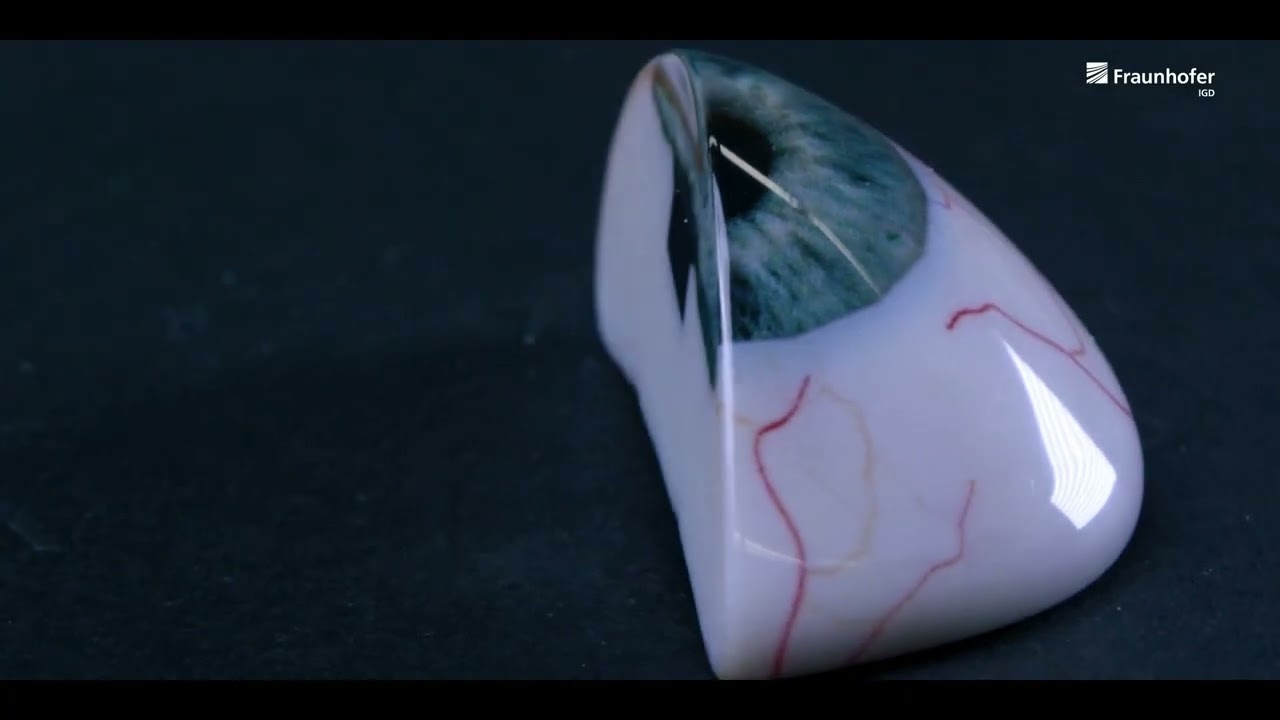
Today’s products are typically made from a combination of different materials, depending on their function, performance requirements, or design objectives. Conventional manufacturing methods often reach their limits in this context, as materials must be processed separately and assembled afterward. Additive manufacturing (3D printing) opens up new possibilities by enabling multiple materials to be combined within a single printing process—including smooth transitions between materials to reduce thermal stresses or to tailor mechanical properties. Material property gradients can even be achieved within a single material through the variation of printing parameters.
These capabilities bring technical challenges. Fraunhofer IGD focuses on the software aspects of the digital process chain and addresses, among others, the following research questions:
- Gradient Modeling in CAD: How can local property gradients be defined directly within a CAD system when traditional CAD models are designed for homogeneous materials?
- Multi-Material Topology Optimization: How can global functional objectives be automatically translated into optimized material distributions?
- Process Integration: How can different printing technologies and base materials be combined to meet local performance requirements?
- Metamaterial Design from a Single Material: How can material property gradients be generated through modified printing parameters without changing the material itself?
- Tool Integration: What information must be captured and transferred throughout the process chain to ensure seamless interaction between all process steps?
3D Color Printing: Precise Control of Visual Properties
A special case of multi-material manufacturing is 3D color printing, in which primary materials are positioned according to color, texture, or gloss within the print volume to create a desired visual appearance. The objective here is not to optimize physical properties (such as mechanical, electrical, or chemical characteristics), but rather to achieve the most accurate visual representation possible.
The Challenge
The capabilities of printing technologies (e.g., material jetting) and the optical properties of available materials are inherently limited. Perfect reproduction is therefore physically difficult to achieve. To overcome these limitations, we employ perceptual models that optimize the printed result based on human visual perception, producing the most realistic appearance possible.
Research Questions We Address:
- How can 3D printers be color-calibrated?
- Which algorithms and data structures are required to realistically simulate color, texture, and light scattering?
- Can methods developed for optimizing material appearance be transferred to geometric optimization in order to reduce geometric inaccuracies?
Our software Cuttlefish® generates print-ready results based on voxel information, light transport models, and printer profiles—delivering outputs that are both visually optimized and technically manufacturable.
With GraMMaCAD and Cuttlefish®, we develop solutions that address these challenges across the entire digital process chain, complemented by research into fast numerical simulation and the optimization of geometry and printing processes.
 Fraunhofer Institute for Computer Graphics Research IGD