 Fraunhofer Institute for Computer Graphics Research IGD
GraMMaCAD helps engineers enhance CAD models with targeted material gradients, enabling them to efficiently create functionally optimized multi-material components.

Functionally integrated photopolymer component printed on a Stratasys J850.
GraMMaCAD – Graded Multi-Material CAD
Interactive CAD software for the efficient design of functionally graded multi-material components for additive manufacturing
Our Solution: Interactive CAD Software for Material Gradients and Multi-Material 3D Printing
GraMMaCAD provides an interactive CAD environment in which material gradients can be defined directly on an existing 3D model. Functionally graded materials—i.e. spatial variations in material properties—can be defined efficiently, including gradients that continuously follow the shape of the component. When the geometry changes, the gradients automatically adapt accordingly.
The software significantly reduces manual effort and enables consistent, reproducible data preparation for multi-material 3D printing processes.

Target Groups and Areas of Application
For design and engineering professionals
GraMMaCAD makes it possible to quickly and interactively add functional material gradients to CAD models of components and prepare them for multi-material 3D printing. Gradients can be defined efficiently and reused when the model geometry changes.
For manufacturers of multi-material 3D printers
The software makes the capabilities of printing technologies that can combine or selectively position multiple materials easy for users to access. This allows customers to take advantage of the printer’s unique capabilities more quickly and use them efficiently in their applications, increasing the attractiveness of multi-material 3D printers.
Challenge in Multi-Material 3D Printing: High Effort Required to Define Material Gradients
In practice, designing functionally graded multi-material components involves considerable effort. Material assignment is often carried out by manually or script-based post-processing of the component slices. These approaches are time-consuming, prone to errors, and highly model-specific. When the geometry changes, the entire material assignment process often has to be repeated.
An efficient, reusable, geometry-based method for defining material gradients is still largely lacking. As a result, the capabilities of state-of-the-art multi-material 3D printers, which can “mix” materials with different properties, remain underutilized.
Practical Examples

Functionally graded ceramic components (LCM) printed using the Lithoz CM process
Ceramic and TPU Components
Lithoz GmbH uses the software to develop graded ceramic components for Lithography-based Ceramic Manufacturing (LCM) and to demonstrate the benefits of its technology.
GraMMaCAD is used at the Fraunhofer Institute for Manufacturing Engineering and Automation IPA to create component prototypes with functionally graded structures in connection with voxeljet GmbH’s High Speed Sintering technology.

TPU-Bauteil gedruckt mit voxeljet HSS-Technologie
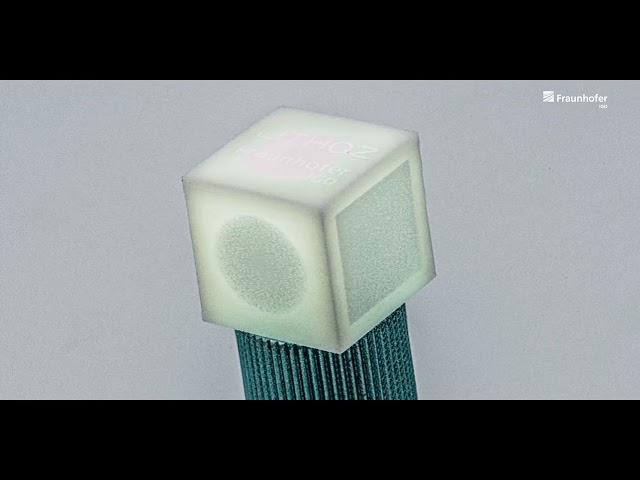
Video: Modeling Material Transitions Directly in CAD – for More Robust Components Without Weak Points
Privacy warning
With the click on the play button an external video from www.youtube.com is loaded and started. Your data is possible transferred and stored to third party. Do not start the video if you disagree. Find more about the youtube privacy statement under the following link: https://policies.google.com/privacyFurther Literatur
- GraMMaCAD: Interactively Defining Spatially Varying FGMs on BRep CAD Models
Luu, Thu Huong; Altenhofen, Christian; Stork, Andre; Fellner, Dieter - Additive Manufacturing Interfaces. AMI Recommendation
Stork, Andre; Balinsky, Helen; Glaesner, Kai Henri; Just, Stefan; Ríos, José - Efficient slicing of Catmull-Clark solids for 3D printed objects with functionally graded material
Luu, Thu Huong; Altenhofen, Christian; Ewald, Tobias; Stork, André; Fellner, Dieter W. - GPU-Parallel Constant-Time Limit Evaluation of Catmull-Clark Solids
Besler, Sebastian; Altenhofen, Christian; Stork, Andre; Fellner, Dieter - Continuous Property Gradation for Multi-Material 3D-printed Objects
Altenhofen, Christian; Grasser, Tim; Luu, Thu Huong; Dennstädt, Marco; Mueller-Roemer, Johannes Sebastian; Weber, Daniel; Stork, André